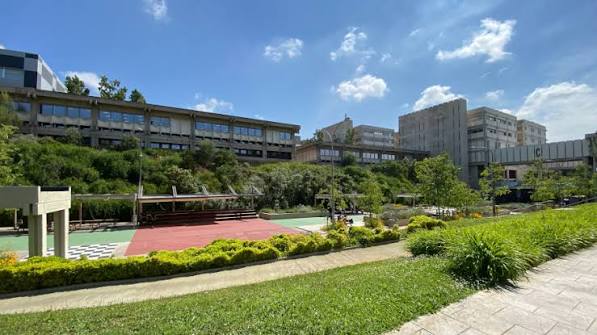
The Universitat Autònoma de Barcelona (UAB) is one of Spain’s leading public universities and a major European centre for teaching, research and innovation.
Founded in 1968 and located in Bellaterra, near Barcelona, UAB has built a strong reputation for academic excellence, internationalisation and interdisciplinary research. Over the years, it has become a key institution in the Spanish and European higher education landscape, consistently ranking among the top universities in Spain and Europe.
In the 2023 QS World University Rankings, UAB was ranked first among Spanish universities, 178th worldwide and 72nd in Europe. These results reflect the university’s strong academic profile, its international visibility and its capacity to combine high-quality teaching with advanced research.
Today, UAB hosts more than 40,000 students, nearly 6,000 academic and research staff, and over 5,000 international students. Its academic offer includes more than 100 bachelor’s degrees, over 140 master’s programmes and 67 doctoral programmes, covering a wide range of fields and disciplines.
A research-driven university
Research is one of UAB’s core strengths. The university produces thousands of scientific publications every year and actively participates in national and international research projects, innovation initiatives and technology transfer activities.
Its commitment to supporting researchers has also been recognised by the European Commission through the HR Excellence in Research award, which highlights the university’s efforts to promote high-quality research careers and responsible research environments.
UAB’s research activities cover a broad spectrum of areas, including biotechnology and health, environmental sciences, sustainability, social sciences, humanities, information technologies, materials and energy.
The university also promotes innovation, entrepreneurship and collaboration with local communities, contributing to the social and economic development of the region. This capacity to connect research, society and local development is particularly relevant for European projects such as CONSPIRE, which aim to link academic knowledge with wider civic and social challenges.
The UAB Sphere: a knowledge ecosystem
UAB is also the centre of the UAB Sphere, a knowledge ecosystem that connects research centres, businesses, public institutions and healthcare organisations.
This ecosystem fosters interdisciplinary collaboration and creates opportunities for researchers, students, institutions and social actors to work together on complex contemporary challenges. It reflects UAB’s broader vision of the university as a space where education, research, innovation and social engagement can reinforce each other.
For CONSPIRE, this environment is especially valuable. The project addresses conspiracy theories, disinformation and radicalisation risks not only as academic topics, but as social phenomena that require dialogue between universities, communities, media, institutions and civil society.
ISOR / BCure: the UAB working group in CONSPIRE
Within CONSPIRE, UAB is represented by ISOR – the Research Centre for the Sociology of Religion, currently transitioning to BCure – Laboratory of Contemporary Studies on Culture and Religion.
Founded in 1974 and affiliated with UAB since 1976, ISOR was the first university research group dedicated to the Sociology of Religion in Catalonia. Over more than four decades, it has become a leading centre for the study of religion, culture and meaning-making processes.
Since 2014, Dr. Maria del Mar Griera has served as director of ISOR, guiding the centre through a period of strong research development, internationalisation and knowledge transfer.
ISOR’s research has a solid theoretical foundation and focuses on different processes related to the construction of meaning. In recent years, the centre has paid increasing attention to religious diversity, social inclusion, religious minorities, memory, identities, and beliefs and perceptions surrounding science and health.
These research lines are directly connected to the core themes of CONSPIRE. Conspiracy theories often emerge at the intersection of health, belief, identity, mistrust and public debate. Understanding these dynamics requires not only media analysis or fact-checking, but also a deeper sociological understanding of how people interpret uncertainty, authority, science and collective life.
Religion, health and conspiracy narratives
The contribution of UAB is particularly important because CONSPIRE investigates conspiracy theories as complex cultural and social phenomena.
The spread of conspiracy narratives related to health, science and public institutions cannot be understood only as a problem of false information. It is also linked to social imaginaries, cultural identities, spiritual beliefs, distrust, symbolic boundaries and the ways in which individuals and communities make sense of crisis.
Through ISOR/BCure, UAB brings to CONSPIRE a strong expertise in the sociology of religion and culture, with a specific focus on the relationships between religion, spirituality, identity, politics, science and health.
This perspective enriches the project’s interdisciplinary approach and helps students understand that conspiracy thinking is not only a digital phenomenon, but also a cultural and social process.
The UAB team
The UAB team involved in CONSPIRE consists of Dr. Maria del Mar Griera Llonch and research assistant Laia Garcia Muñoz.
Dr. Maria del Mar Griera Llonch is Full Professor in the Department of Sociology at UAB and Director of ISOR. Her work focuses on the intersections between religion, spirituality, identity and politics in contemporary Europe.
She has led numerous nationally and internationally funded research projects, published extensively in leading academic journals and books, and has been actively involved in knowledge-transfer initiatives with public administrations and civil society organisations.
Her expertise is particularly relevant for CONSPIRE because the project explores how beliefs, narratives and forms of mistrust shape public understandings of health, science, institutions and democracy.
Laia Garcia Muñoz is a research assistant at ISOR. Her interests lie at the intersection of the sociology of culture, communication studies, social networks and youth cultures, with a particular focus on identity formation and social imaginaries.
She holds a degree in Sociology from UAB and is currently completing a Master’s degree in Communication Research at Universitat Pompeu Fabra. She has collaborated on several interdisciplinary projects in the fields of sociology, psychology and communication.
Her profile brings to the project a valuable perspective on young people, communication, identity and the circulation of meanings in contemporary societies.
UAB’s role in CONSPIRE
Within CONSPIRE, UAB contributes to the project’s interdisciplinary analysis of conspiracy theories, with particular attention to the intersections between health, religion, spirituality, culture and social imaginaries.
Its expertise supports the project’s broader educational ambition: helping students understand how conspiracy narratives are constructed, why they become persuasive and how they interact with identity, belief, mistrust and public debate.
This contribution is especially relevant in a project that brings non-formal education methods into formal university settings. CONSPIRE does not only provide students with theoretical knowledge. It invites them to analyse, discuss, simulate and reflect on conspiracy thinking through innovative educational tools, role-playing activities, community-based learning and participatory methodologies.
In this framework, UAB’s sociological and cultural expertise helps strengthen the quality of the training programme and the students’ capacity to critically engage with complex information environments.
A partner connecting research and society
UAB’s participation in CONSPIRE reflects the university’s wider mission: producing high-quality research, promoting international cooperation and connecting academic knowledge with society.
Through ISOR/BCure, the university brings to the project a long-standing tradition in the study of religion, culture, identity and meaning-making processes, together with a strong commitment to knowledge transfer and public engagement.
In a time when misinformation and conspiracy theories often exploit uncertainty, fear and distrust, this perspective is essential. It helps CONSPIRE go beyond simple debunking and supports a deeper educational approach based on critical thinking, civic awareness and democratic dialogue.
By contributing its academic excellence and sociological expertise, the Universitat Autònoma de Barcelona strengthens CONSPIRE’s European mission: to help students understand conspiracy thinking, develop media and civic competences, and become more active, critical and responsible participants in democratic life.